WW.IMOSHL.2022.G8 en
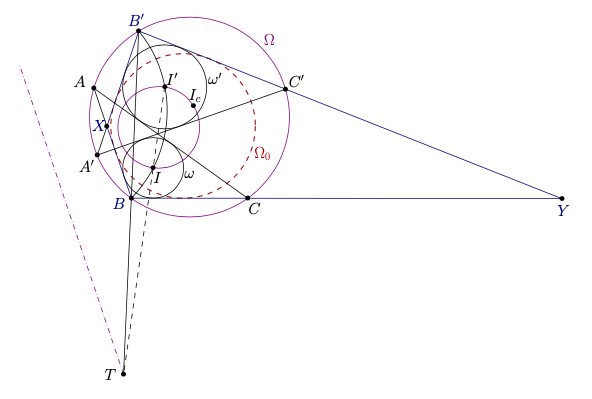
Let \(AA'BCC'B'\) be a convex cyclic hexagon such that \(AC\) is tangent to the incircle of the triangle \(A'B'C'\), and \(A'C'\) is tangent to the incircle of the triangle \(ABC\). Let the lines \(AB\) and \(A'B'\) meet at \(X\) and let the lines \(BC\) and \(B'C'\) meet at \(Y\).
Prove that if \(XBYB'\) is a convex quadrilateral, then it has an incircle.
Solution
Denote by \(\omega\) and \(\omega^{\prime}\) the incircles of \(\triangle ABC\) and \(\triangle A^{\prime} B^{\prime} C^{\prime}\) and let \(I\) and \(I^{\prime}\) be the centres of these circles. Let \(N\) and \(N^{\prime}\) be the second intersections of \(B I\) and \(B^{\prime} I^{\prime}\) with \(\Omega\), the circumcircle of \(A^{\prime} B C C^{\prime} B^{\prime} A\), and let \(O\) be the centre of \(\Omega\). Note that \(O N \perp A C, O N^{\prime} \perp A^{\prime} C^{\prime}\) and \(O N=O N^{\prime}\) so \(N N^{\prime}\) is parallel to the angle bisector \(I I^{\prime}\) of \(A C\) and \(A^{\prime} C^{\prime}\). Thus \(I I^{\prime} \| N N^{\prime}\) which is antiparallel to \(B B^{\prime}\) with respect to \(B I\) and \(B^{\prime} I^{\prime}\). Therefore \(B, I, I^{\prime}, B^{\prime}\) are concyclic.
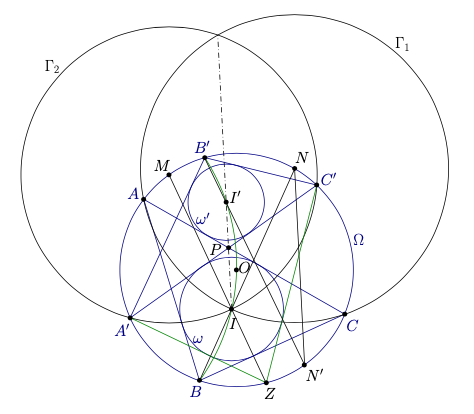
Further define \(P\) as the intersection of \(A C\) and \(A^{\prime} C^{\prime}\) and \(M\) as the antipode of \(N^{\prime}\) in \(\Omega\). Consider the circle \(\Gamma_{1}\) with centre \(N\) and radius \(N A=N C\) and the circle \(\Gamma_{2}\) with centre \(M\) and radius \(M A^{\prime}=M C^{\prime}\). Their radical axis passes through \(P\) and is perpendicular to \(M N \perp N N^{\prime} \| I P\), so \(I\) lies on their radical axis. Therefore, since \(I\) lies on \(\Gamma_{1}\), it must also lie on \(\Gamma_{2}\). Thus, if we define \(Z\) as the second intersection of \(M I\) with \(\Omega\), we have that \(I\) is the incentre of triangle \(Z A^{\prime} C^{\prime}\). (Note that the point \(Z\) can also be constructed directly via Poncelet's porism.)
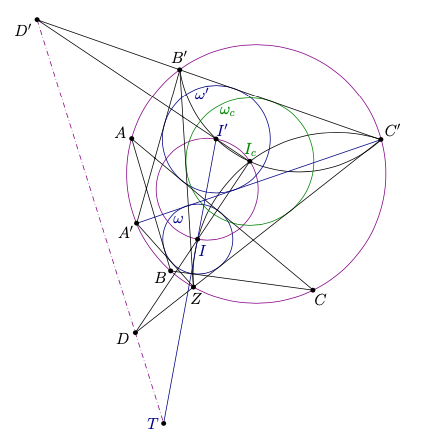
Consider the incircle \(\omega_{c}\) with centre \(I_{c}\) of triangle \(C^{\prime} B^{\prime} Z\). Note that \(\angle Z I C^{\prime}=90^{\circ}+\) \(\frac{1}{2} \angle Z A^{\prime} C^{\prime}=90^{\circ}+\frac{1}{2} \angle Z B^{\prime} C^{\prime}=\angle Z I_{c} C^{\prime}\), so \(Z, I, I_{c}, C^{\prime}\) are concyclic. Similarly \(B^{\prime}, I^{\prime}, I_{c}, C^{\prime}\) are concyclic.
The external centre of dilation from \(\omega\) to \(\omega_{c}\) is the intersection of \(I I_{c}\) and \(C^{\prime} Z(D\) in the picture), that is the radical centre of circles \(\Omega, C^{\prime} I_{c} I Z\) and \(I I^{\prime} I_{c}\). Similarly, the external centre of dilation from \(\omega^{\prime}\) to \(\omega_{c}\) is the intersection of \(I^{\prime} I_{c}\) and \(B^{\prime} C^{\prime}\) ( \(D^{\prime}\) in the picture), that is the radical centre of circles \(\Omega, B^{\prime} I^{\prime} I_{c} C^{\prime}\) and \(I I^{\prime} I_{c}\). Therefore the Monge line of \(\omega, \omega^{\prime}\) and \(\omega_{c}\) is line \(D D^{\prime}\), and the radical axis of \(\Omega\) and circle \(I I^{\prime} I_{c}\) coincide. Hence the external centre \(T\) of dilation from \(\omega\) to \(\omega^{\prime}\) is also on the radical axis of \(\Omega\) and circle \(I I^{\prime} I_{c}\).
Now since \(B, I, I^{\prime}, B^{\prime}\) are concyclic, the intersection \(T^{\prime}\) of \(B B^{\prime}\) and \(I I^{\prime}\) is on the radical axis of \(\Omega\) and circle \(I I^{\prime} I_{c}\). Thus \(T^{\prime}=T\) and \(T\) lies on line \(B B^{\prime}\). Finally, construct a circle \(\Omega_{0}\) tangent to \(A^{\prime} B^{\prime}, B^{\prime} C^{\prime}, A B\) on the same side of these lines as \(\omega^{\prime}\). The centre of dilation from \(\omega^{\prime}\) to \(\Omega_{0}\) is \(B^{\prime}\), so by Monge's theorem the external centre of dilation from \(\Omega_{0}\) to \(\omega\) must be on the line \(T B B^{\prime}\). However, it is on line \(A B\), so it must be \(B\) and \(B C\) must be tangent to \(\Omega_{0}\) as desired.