WW.IMOSHL.2022.G5 en
Let \(ABC\) be a triangle and \(\ell_1,\ell_2\) be two parallel lines. Let \(\ell_i\) intersects line \(BC,CA,AB\) at \(X_i,Y_i,Z_i\), respectively. Let \(\Delta_i\) be the triangle formed by the line passed through \(X_i\) and perpendicular to \(BC\), the line passed through \(Y_i\) and perpendicular to \(CA\), and the line passed through \(Z_i\) and perpendicular to \(AB\). Prove that the circumcircles of \(\Delta_1\) and \(\Delta_2\) are tangent.
Solution-2
As in the first solution, let the vertices of \(\Delta_{i}\) be \(D_{i}, E_{i}, F_{i}\), such that \(E_{i} F_{i}, F_{i} D_{i}\) and \(D_{i} E_{i}\) are the perpendiculars through \(X_{i}, Y_{i}\) and \(Z_{i}\), respectively. In the same way we conclude that \(\left(A, D_{1}, D_{2}\right),\left(B, E_{1}, E_{2}\right)\) and \(\left(C, F_{1}, F_{2}\right)\) are collinear.
The corresponding sides of triangles \(ABC\) and \(D_{i}E_{i}F_{i}\) are perpendicular to each other. Hence, there is a spiral similarity with rotation \(\pm 90^{\circ}\) that maps \(A B C\) to \(D_{i} E_{i} F_{i}\); let \(M_{i}\) be the centre of that similarity. Hence, \(\sphericalangle\left(M_{i} A, M_{i} D_{i}\right) = \sphericalangle\left(M_{i} B, M_{i} E_{i}\right) = \sphericalangle\left(M_{i} C, M_{i} F_{i}\right)=90^{\circ}\). The circle with diameter \(A D_{i}\) passes through \(M_{i}, Y_{i}, Z_{i}\), so \(M_{i}, A, Y_{i}, Z_{i}, D_{i}\) are concyclic; analogously \(\left(M_{i}, B, X_{i}, Z_{i}, E_{i}\right)\) and \(\left(M_{i}, C, X_{i}, Y_{i}, F_{i}\right)\) are concyclic.
By applying Desargues' theorem to triangles \(A B C\) and \(D_{i}E_{i}F_{i}\) we conclude that the lines \(AD_{i}\), \(BE_{i}\) and \(BF_{i}\) are concurrent; let their intersection be \(H\). Since \(\left(A, D_{1} . D_{2}\right)\), \(\left(B, E_{1} . E_{2}\right)\) and \(\left(C, F_{1} . F_{2}\right)\) are collinear, we obtain the same point \(H\) for \(i=1\) and \(i=2\).
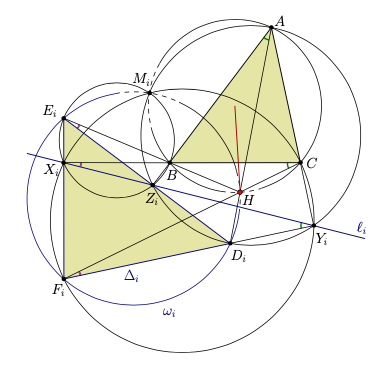
By \(\sphericalangle(C B, C H)=\sphericalangle\left(C X_{i}, C F_{i}\right)=\sphericalangle\left(Y_{i} X_{i}, Y_{i} F_{i}\right)=\sphericalangle\left(Y_{i} Z_{i}, Y_{i} D_{i}\right)=\sphericalangle\left(A Z_{i}, A D_{i}\right)=\) \(\sphericalangle(A B, A H)\), point \(H\) lies on circle \(ABC\).
Analogously, from \(\sphericalangle\left(F_{i} D_{i}, F_{i} H\right)=\sphericalangle\left(F_{i} Y_{i}, F_{i} C\right)=\sphericalangle\left(X_{i} Y_{i}, X_{i} C\right)=\sphericalangle\left(X_{i} Z_{i}, X_{i} B\right)=\) \(\sphericalangle\left(E_{i} Z_{i}, E_{i} B\right)=\sphericalangle\left(E_{i} D_{i}, E_{i} H\right)\), we can see that point \(H\) lies on circle \(D_{i} E_{i} F_{i}\) as well. Therefore, circles \(A B C\) and \(D_{i} E_{i} F_{i}\) intersect at point \(H\).
The spiral similarity moves the circle \(A B C\) to circle \(D_{i} E_{i} F_{i}\), so the two circles are perpendicular. Hence, both circles \(D_{1} E_{1} F_{1}\) and \(D_{2} E_{2} F_{2}\) are tangent to the radius of circle \(A B C\) at \(H\).
Comment 1. As the last picture suggests, the circles \(A B C\) and \(D_{i} E_{i} F_{i}\) pass through \(M_{i}\). In fact, point \(M_{i}\), being the second intersection of circles \(D_{i} E_{i} F_{i}\) and \(D_{i} Y_{i} Z_{i}\), the Miquel point of the lines \(A Y_{i}, A Z_{i}, C X_{i}\) and \(X_{i} Y_{i}\), so it is concyclic with \(A, B, C\). Similarly, \(M_{i}\) the Miquel point of lines \(D_{i} E_{i}\), \(E_{i} F_{i}, F_{i} Y_{i}\) and \(X_{i} Y_{i}\), so it is concyclic with \(D_{i}, E_{i}, D_{i}\).
Comment 2. Instead of two lines \(\ell_{1}\) and \(\ell_{2}\), it is possible to reformulate the problem with a single, varying line \(\ell\):
Let \(A B C\) be a triangle, and let \(\ell\) be a varying line whose direction is fixed. Let \(\ell\) intersect lines \(B C\), \(C A\), and \(AB\) at \(X,Y\), and \(Z\), respectively. Suppose that the line through \(X\), perpendicular to \(BC\), the line through \(Y\), perpendicular to \(CA\), and the line through \(Z\), perpendicular to \(AB\), determine a non-degenerate triangle \(\Delta\).
Show that as \(\ell\) varies, the circumcircles of the obtained triangles \(\Delta\) pass through a fixed point, and these circles are tangent to each other.
A reasonable approach is finding the position of line \(\ell\) when the triangle \(DEF\) degenerates to a single point. That happens when the line \(XYZ\) is the Simson line respect to point \(D=E=F\) on the circumcircle \(ABC\). Based on this observation a possible variant of the solution is as follows.
Let \(H\) be the second intersection of circles \(A B C\) and line \(AD\). Like in the solutions above, we can find that the line \(AD\) is fixed, so \(H\) is independent of the position of line \(\ell\).
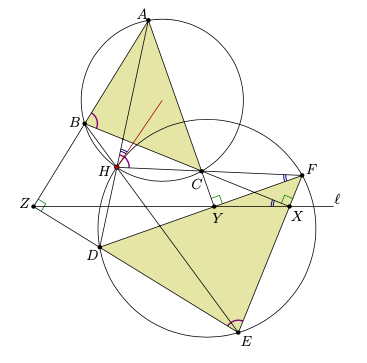
From \(\sphericalangle(H F, H D)=\sphericalangle(H C, H A)=\sphericalangle(B C, B A)=\sphericalangle(B X, B Z)=\sphericalangle(E X, E Z)=\sphericalangle(E F, E D)\) we can see that circle \(\Delta\) passes through \(H\). Hence, all circles \(D E F\) passes through a fixed point.
The corresponding sides of triangles \(A B C\) and \(D E F\) are perpendicular, so their circumcircle are perpendicular; that proves that circle \(DEF\) is tangent to the radius of circle \(ABC\) at \(H\).