WW.IMOSHL.2022.G3 en
Let \(ABCD\) be a cyclic quadrilateral. Assume that the points \(Q, A, B, P\) are collinear in this order, in such a way that the line \(AC\) is tangent to the circle \(ADQ\), and the line \(BD\) is tangent to the circle \(BCP\). Let \(M\) and \(N\) be the midpoints of segments \(BC\) and \(AD\), respectively. Prove that the following three lines are concurrent: line \(CD\), the tangent of circle \(ANQ\) at point \(A\), and the tangent to circle \(BMP\) at point \(B\).
Solution-2
We present a second solution, without using the condition that \(ABCD\) is cyclic. Again, \(M\) and \(N\) can be any points on lines \(BC\) and \(AD\) such that \(BM:MC=DN:NA\).
Let \(AB\) and \(CD\) meet at \(T\) (if \(AB \| CD\) then \(T\) is their common ideal point). Let \(CD\) meet the tangent to the circle \(ANQ\) at \(A\), and the tangent to the circle \(BMP\) at \(B\) at points \(K_{1}\) and \(K_{2}\), respectively.
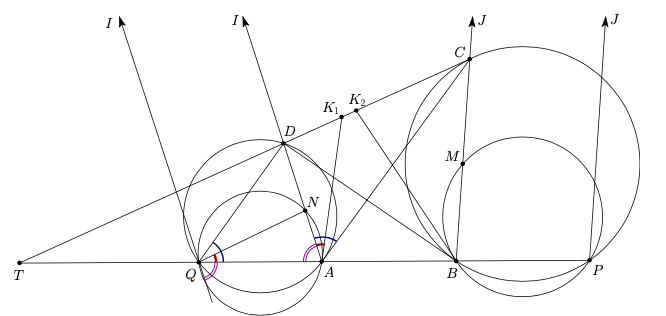
Let \(I\) and \(J\) be the ideal points of \(AD\) and \(BC\), respectively. Notice that the pencils \(\left(AD, AC, AT, AK_{1}\right)\) and \((QA, QD, QI, QN)\) of lines are congruent, because \(\angle K_{1} AD=\angle AQN\), \(\angle CAD=\angle AQD\) and \(\angle IAT = \angle IQT\). Hence,
\[\left(D, C ; T, K_{1}\right) = \left(A D, A C ; A T, A K_{1}\right) = (QA, QD ; QI, QN)=(A,D ; I,N)=\frac{DN}{NA}\]
It can be obtained analogously that\[\left(D,C ; T,K_{2}\right)=\left(BD,BC ; BT,BK_{2}\right)=(PC,PB ; PJ,PM)=(C,B ; I,N) = \frac{BM}{MC}\]
From \(BM:MC = DN:DA\) we get \(\left(D,C ; T,K_{1}\right) = \left(D,C ; T,K_{2}\right)\) and hence \(K_{1}=K_{2}\).